How a meme coin trade turned $22,000 in 2026 for one trader with a full guide
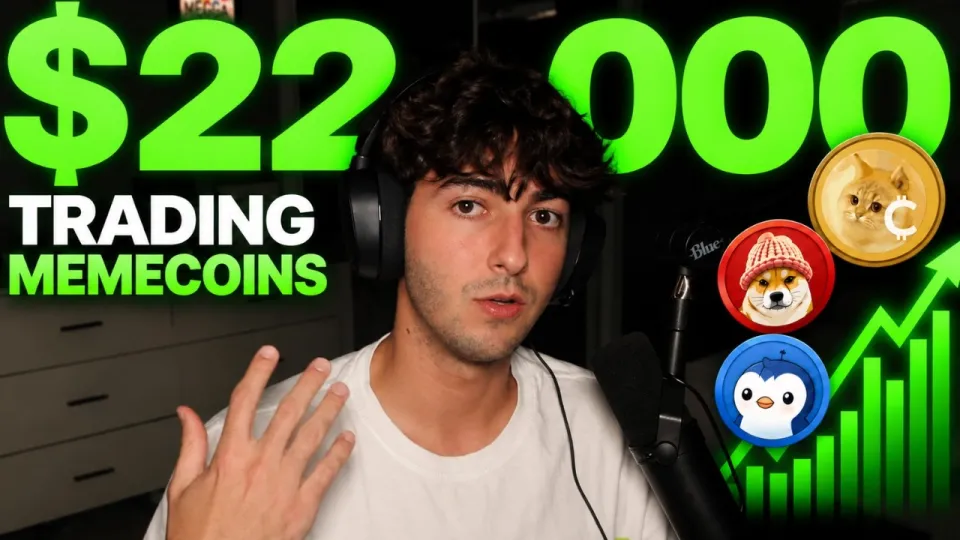
Video: How I Made $22,000 in a SINGLE Memecoin Trade (FULL GUIDE)
Want articles like this for your own video to promote it on YouTube and Google? Order them through the Telegram bot @sat_sit_bot. Articles with your video embedded are written and posted by the bot itself — on popular topical sites (no ads). Try it free: 50 articles on us.
· based on the channel Megga
Key takeaways
- Megga reports a single meme coin trade that produced $22,000 in profit, broken down step by step in a full guide.
- The workflow starts with a free beginners guide hosted on Whop, followed by the padre.gg trading terminal for execution.
- Meme coin P&L is driven by entry speed, position sizing and exit discipline rather than by holding long term.
- Viewers questioned whether the result is repeatable outside a KOL network, which is a real risk factor for copy traders.
- Small-account challenges such as turning $25–$100 into $1,000 were the most requested follow-up from the audience.
A meme coin trade is a short-horizon speculative position in a low-cap token launched on a decentralized exchange, and the $22,000 result Megga reports came from exactly that: one token, one position, one exit. The guide walks through the full path from a free beginners resource to execution on a trading terminal, with the profit coming from timing and sizing rather than from holding a coin for months.
Megga's breakdown is built around two tools: the free beginners guide on Whop, which covers wallet setup and the basics of on-chain trading, and the padre.gg terminal used to route orders. The $22,000 figure is a single-trade outcome, which means the important part of the story is not the number itself but the process that produced it.
What a meme coin is and why single trades can pay $22,000
A meme coin is a token with no cash-flow claim, launched cheaply and traded almost entirely on attention, liquidity and narrative. Because these tokens start with tiny market capitalizations, a modest inflow of buyers can move the price by hundreds of percent within minutes, and equally fast outflows can erase the same move. That asymmetry is what makes a five-figure result possible on one position — and what makes a total loss possible on the same position.
The mechanics that matter for a trade of this size are liquidity depth, holder concentration and the speed at which you can get in and out. A token with thin liquidity cannot absorb a large sell without collapsing, so the practical ceiling on any single trade is set by how much the pool can pay out, not by how good the chart looks.
The step-by-step workflow behind the trade
- Learn the basics first. The free beginners guide at whop.com/wiredd covers wallet creation, seed-phrase security, funding with SOL or ETH and the difference between a swap and a limit order.
- Set up a dedicated wallet. Meme coin trading requires signing transactions with a hot wallet, so it should hold only risk capital and never the main portfolio.
- Connect a terminal. The padre.gg terminal provides faster order routing, price charts and one-click execution compared with a standard DEX interface, which matters when a token's first minutes decide the outcome.
- Screen candidates before they trend. Check contract permissions, holder distribution, liquidity locked or burned, and whether the deployer wallet has a history of dumping.
- Size the position so a total loss is survivable. A trade that can return $22,000 can also return zero, so the amount committed must be money the trader can lose entirely.
- Define the exit before entering. Take partial profit into strength, move the remainder to a trailing stop, and accept that the top of a meme coin chart is almost never sellable in full.
Risk control that separates a $22,000 trade from a wipeout
Position sizing is the only risk control that survives contact with a fast market. If a trader risks 5% of capital per attempt and one attempt returns a multiple, the account grows; if the same trader risks 50% per attempt, a single failed launch ends the experiment. The $22,000 outcome implies a meaningful starting position, so the loss on the same trade would have been equally meaningful.
The second control is liquidity awareness. Before buying, estimate how much of the pool your exit would represent; if selling your full position would remove a large share of the liquidity, the position is too big for that token. The third is contract safety: mint authority, freeze authority and hidden transfer taxes are the standard ways traders lose money without a price crash ever happening. A meme coin trade is a bet on market psychology, but the losses usually come from technical details.
The KOL advantage and whether the result is repeatable
The most substantive pushback on the video is whether the outcome depends on being a known trader with a network of friends in the same tokens. That criticism has merit: when a recognizable account buys a low-cap token, its followers see the wallet activity and buy alongside, which improves the entry and the exit for the original trader. A trader without that audience faces wider spreads, slower fills and less exit liquidity.
The honest way to read the $22,000 figure is as an upper bound for a well-connected trader, not a baseline expectation. Traders without a following should assume worse fills, more failed attempts and a longer learning curve, and should judge themselves on process — did the entry follow the plan, was the exit disciplined — rather than on whether they matched a headline number. Copy-trading a KOL's wallet after the fact usually means buying the exit liquidity, not sharing the profit.
Common questions and doubts from traders
The most frequent request from viewers is a smaller-scale challenge: starting with $25 to $100 and trying to build it to $1,000. That framing is more useful than a five-figure headline because it forces correct sizing and shows how fees, failed launches and slippage eat into small accounts. On-chain fees on a busy chain can consume a noticeable share of a $50 position, so small-account traders should expect the learning phase to be slow.
Another recurring question concerns token categories beyond the classic launch: tweet coins, profile coins and community coins, each with different supply mechanics and different reasons to hold. A profile coin is tied to a person's identity, a community coin to a group, and a tweet coin to a single post's attention cycle — the trading rules differ mainly in how long the narrative can plausibly last. Beginners should master one category before adding others, since each has its own rug patterns and liquidity behavior.
Tools and links from the breakdown
- Free beginners guide (wallet setup, basics, onboarding): https://whop.com/wiredd
- Trading terminal used for execution: https://trade.padre.gg/rk/megga
- Twitch streams: http://www.twitch.tv/megga
- TikTok: https://www.tiktok.com/@meggafaze
- Twitter/X: https://twitter.com/megga
Final takeaway
A $22,000 meme coin trade is a real outcome, but it is the product of preparation, position sizing and exit discipline far more than luck or a single call. Megga's breakdown is valuable because it shows the full chain — free education, a dedicated wallet, a fast terminal, screening rules and a predefined exit — rather than just the profit screenshot. Traders who want to follow the same path should start with the free beginners guide on Whop, paper-trade the process first, and treat every position as money that can go to zero. The channel Megga deserves credit for publishing the workflow openly, including the parts that depend on being a known trader.
None of this is financial advice. Meme coin trading carries a high risk of total loss.
Questions & answers
How much capital do you need to make a $22,000 meme coin trade?
There is no fixed minimum, but the result scales with position size and the token's liquidity. A trade capable of returning $22,000 also implies a substantial amount at risk, so the position must be sized so that a total loss does not damage the account. Small accounts should focus on process and smaller targets first.
Is the result repeatable without a large following?
It is harder. A recognized trader benefits from followers buying the same token, which improves fills and exit liquidity. Without that audience, expect wider spreads, slower execution and more failed attempts, so judge results against your own plan rather than a headline figure.
What tools are used in the guide?
The workflow relies on a free beginners guide on Whop for wallet setup and basics, plus the padre.gg trading terminal for faster order routing and execution. A dedicated hot wallet holding only risk capital is part of the setup.
How do you avoid rug pulls when trading meme coins?
Check mint and freeze authority, holder concentration, locked or burned liquidity and the deployer wallet's history before buying. Estimate whether your exit would drain a large share of the pool, and never commit funds you cannot afford to lose entirely.
Source: How I Made $22,000 in a SINGLE Memecoin Trade (FULL GUIDE) · Markdown version